
Criminal Court Records in Manistee County
A criminal court record is the case file that a court opens when a person is charged with a crime. It is not the same as an arrest log or a jail booking sheet. The file is built and kept by the court, and it grows with every step of the case. Each filing, hearing, plea, and order is logged in the docket. The record ends with a disposition and, where there is a conviction, a sentence.
Two local trial courts build these files. The 85th District Court handles misdemeanor crimes, and it also opens the file for every felony at the start. The 19th Circuit Court is the felony trial court once a case is bound over. Felonies charged at the Oaks Correctional Facility, a state prison in the county, are heard in the circuit court as well. The Manistee County Clerk serves as Clerk of the Circuit Court, so felony and higher case files route through that office, while the district court keeps its own counter and public terminal.
The line between a charge and the case file matters. The charge is the accusation the prosecutor files; the case file is everything the court records after that. A closer look at the charges themselves, from complaint to charge status, lives in the Manistee County arrest records and court charges pages.
Which Courts Hold Manistee County Criminal Cases
Where a criminal case lives depends on how serious the charge is. A misdemeanor is a lesser crime, and it stays in the district court from start to finish. A felony is a serious crime, and it is treated in two stages. The district court opens the felony and holds the early steps. If the judge finds probable cause, the case is bound over, which means it is sent up to the circuit court for trial and sentencing.
This split shapes where the record sits. Early felony events, such as the complaint, the first appearance, and the probable cause finding, show up in a district court file. The rest of the felony, from the information through the verdict and sentence, shows up in a circuit court file. Both files are searched through the same statewide system, but under different court codes.
- 85th District Court: misdemeanors from start to finish, plus the opening and early stages of every felony before bindover.
- 19th Circuit Court: felony trials and sentencing after bindover, and felonies charged at Oaks Correctional Facility.
- Michigan Court of Appeals: appeals from the trial courts after a conviction or final order.
Note: a felony that begins in the district court and moves up to the circuit court can leave two connected files, one in each court's case search.
Who Prosecutes and Defends These Cases
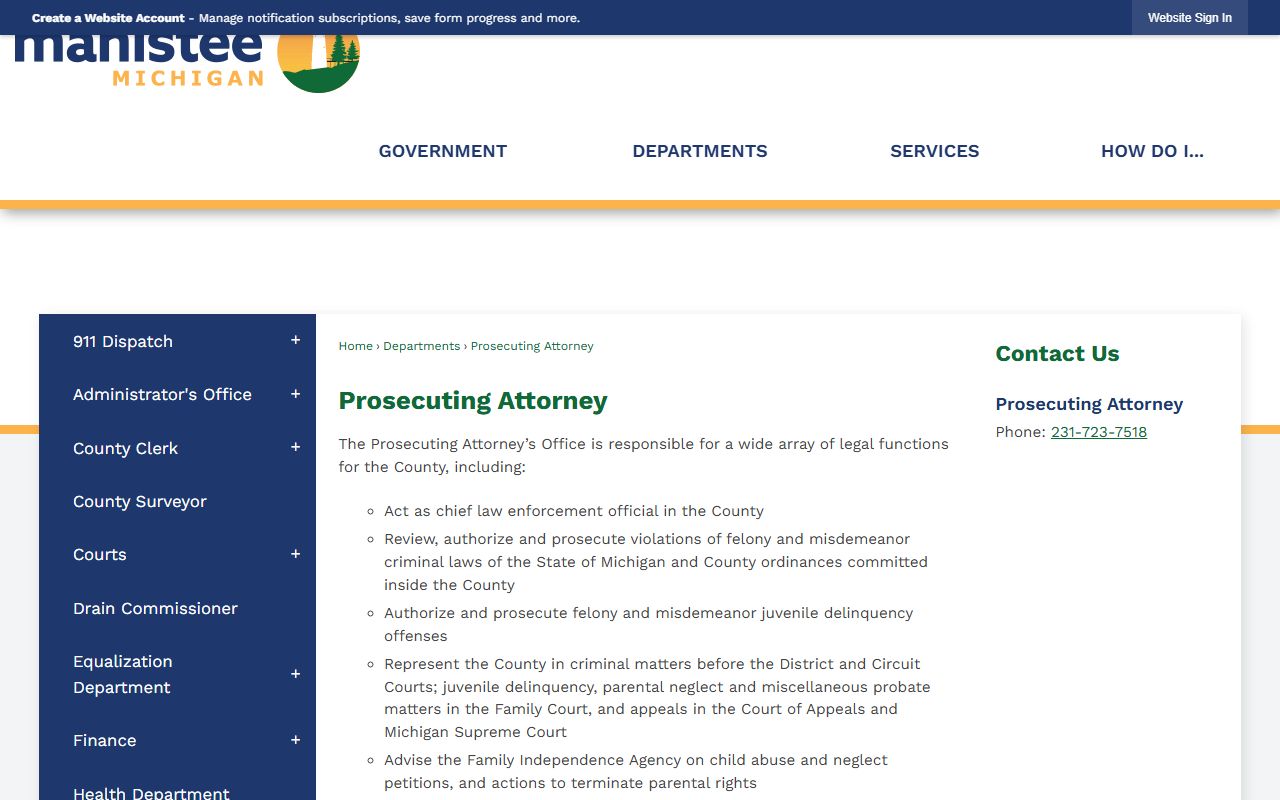
A criminal case has two sides on the record. The prosecutor represents the people of the state and decides which charges to file. The Manistee County Prosecuting Attorney is the chief law enforcement official in the county, and the office reviews, authorizes, and prosecutes felony and misdemeanor charges in both the district and circuit courts. The prosecutor also handles juvenile delinquency matters and criminal appeals.
The Manistee County Prosecuting Attorney page lists these duties and the office phone, 231-723-7518. The screenshot below shows that official page.
The prosecutor's name appears on the charging documents in a criminal court record. Prosecutor Jon Hauswirth leads the office, and recent reporting notes the office moved roughly 1,000 cases and about 20 trials in a single year. Names and contacts for the office are listed in the Prosecuting Attorney staff directory, shown here.
The other side is the defense. A defendant who cannot afford a lawyer may get a court-appointed one. The Regional Public Defender office serves Manistee County from an office at the courthouse. Its details appear in the image below and the card that follows.
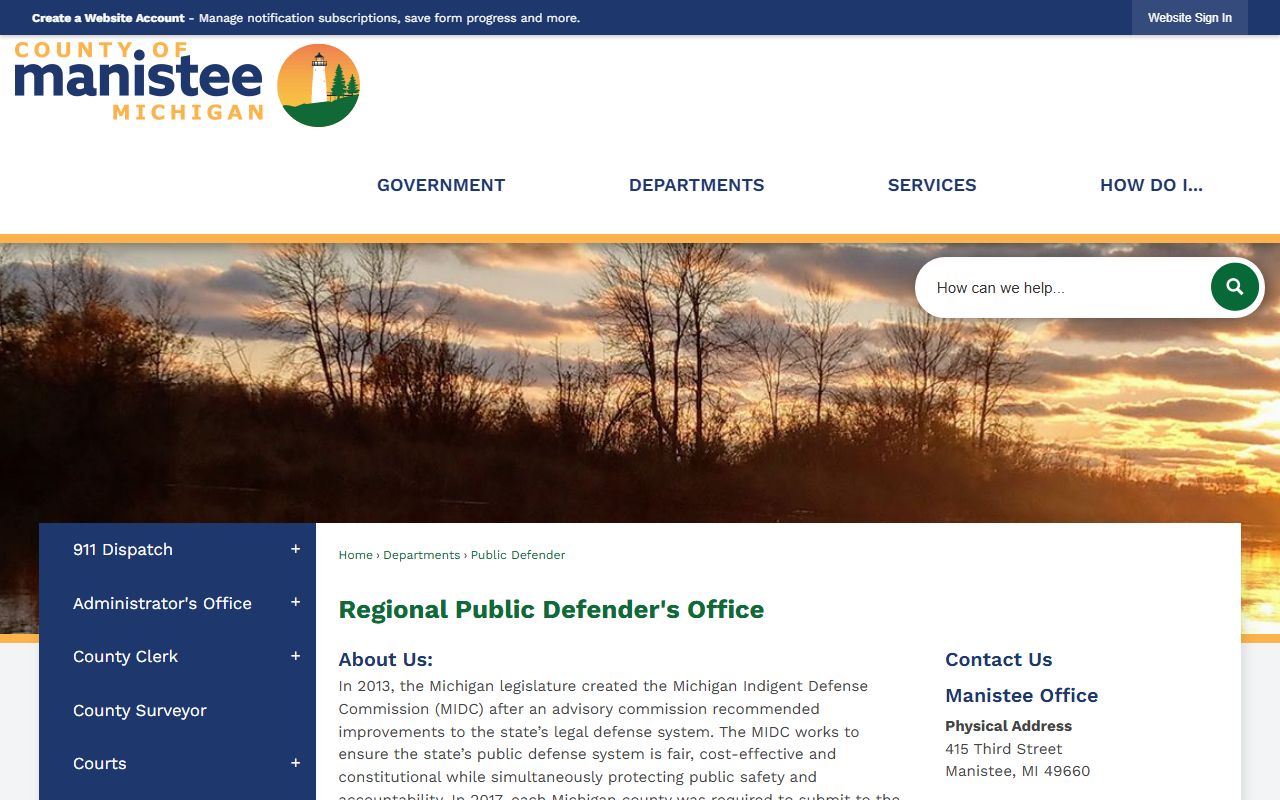
Manistee, MI 49660
Phone: 231-398-3522
Fax: 231-398-3528
Chief Public Defender: Jane Johnson
Stages of a Manistee County Criminal Case
A criminal case moves through set steps, and each step leaves a mark in the record. Reading the docket in order shows how the case grew and where it ended. The flow is the same for most cases, though a felony adds a probable cause step before it moves to the circuit court.
Case flow: Charges Filed › Arraignment › Pretrial / Motions › Plea or Trial › Disposition › Sentencing
Charges are filed after the prosecutor reviews the case and authorizes a complaint. From there the case runs through the steps below. Each stage adds docket entries, and the last two set the outcome.
- Arraignment
- The first court appearance. The defendant hears the charges, learns their rights, and may enter a plea. Bond is set here.
- Pretrial / Motions
- Lawyers exchange information and file written requests. A felony has a probable cause step, and bindover sends it to the circuit court.
- Plea or Trial
- The case is settled by a plea or decided at trial by a judge or jury.
- Sentencing
- After a conviction, the judge sets the punishment: jail or prison, probation, fines, costs, or restitution.
How to Search Manistee County Criminal Court Records
Michigan runs a free public case search called MiCOURT. It covers criminal cases in both the district and circuit courts, and it can be searched by defendant name or case number. The county pages link straight to each court, which avoids picking the wrong court in a statewide search. The site needs JavaScript, and full document images are usually not posted online.
- Open the 85th District Court case search for misdemeanors and traffic, or the 19th Circuit Court case search for felonies.
- Search by case number if it is known, since that is the most exact path and works across name changes and aliases.
- Search by defendant first and last name for public case types; some records may not return by name.
- Narrow the results with filters for case type, case status, offense date, or disposition date.
- Open the case to read the docket, the charges, hearing dates, and the disposition.
- Request a certified copy from the clerk who holds the case if a court-ready copy is needed.
When a record does not appear online, there are other channels. The district court keeps a public view-only terminal at its counter, and a printout costs $1 per page. Circuit and felony files are held by the county clerk. A record that never shows online may be restricted rather than missing.
What a Manistee County Criminal Court Record Shows
A criminal court record is built from fields, and each field answers one question about the case. Some fields are set when the file opens, such as the case number and the parties. Others fill in as the case moves, such as the plea, the disposition, and the sentence. The table below walks through the main fields a case search returns.
| Field | What It Shows |
|---|---|
| Case Number | The court-assigned number, with a year and a two-letter code for the case type. |
| Court | The 85th District Court, the 19th Circuit Court, or another trial court holding the file. |
| Defendant | The person charged, listed as a participant along with the prosecutor and any attorney. |
| Charges | Each count, its statute, the offense date, and the charge status. |
| Docket Entries | The dated list of filings and events, from complaint to arraignment to judgment. |
| Plea | The defendant's formal answer, such as guilty, not guilty, or no contest. |
| Disposition | How each charge ended, with the disposition date. |
| Sentence | The punishment after a conviction, plus probation terms and restitution. |
| Financials | Fines, costs, court assessments, amount due, and amount paid. |
Not every field is open to the public. Cases in the juvenile, adoption, and mental health streams may be suppressed, and personal data such as Social Security numbers is redacted.
Reading Dispositions and Sentences
The disposition is how a charge or case was resolved. It is the single most useful field in the file, and it tells the reader whether the case ended in a conviction, a dismissal, or an acquittal. A sentence appears only after a conviction, and it can mix several parts. Some short terms show up often, and knowing them makes the record easy to read.
- Disposition
- How a charge or case was resolved.
- Dismissed with prejudice
- Dismissed and barred from being refiled on the same claim.
- Dismissed without prejudice
- Dismissed, but the charge may be refiled if allowed.
- No contest
- A plea that accepts the penalty without admitting guilt.
- Probation
- Court supervision served instead of, or after, jail or prison.
- Restitution
- Money the court orders paid to a victim for loss.
A sentence line may set jail or prison time, probation, fines, costs, and restitution together. The financial fields then track what is owed and what has been paid, so a closed case can still carry a balance due.
Charges vs. Convictions
Being charged is not the same as being convicted. A charge is only an accusation, and a criminal court record often shows charges that were dropped, dismissed, or ended in an acquittal. A conviction is a finding of guilt, set either by a plea or by a verdict. Reading a record the right way means checking the disposition, not just the charge that opened the case.
| Charge | Conviction | |
|---|---|---|
| Stage | Accusation at the start | Verdict or plea at the end |
| Burden of Proof | Probable cause | Beyond a reasonable doubt |
| Meaning | The case is not yet decided | Guilt is established |
| Public Record | Yes | Yes |
A charge can also change on its way through a case. It may be amended, reduced, or dismissed before any finding. The final word is always the disposition line.
Public Access to Manistee County Criminal Court Records
Most criminal court records in Michigan are open to the public. Court files are governed by court rule, not by the general open-records law, so the first stop is the court system rather than a records request. MiCOURT and the district court terminal provide the case data, while the clerk offices remain the official keepers of copies and certified copies. The public-records law still matters for police and county records, such as incident reports without pending charges.
Key Statutes:
Michigan Court Rule 8.119 - governs how court case records are kept, inspected, and copied, and which records are restricted.
Michigan FOIA, MCL 15.231 et seq. - requires public bodies to release public records on written request, while court files stay under the court rules.
Sealed vs. Expunged and Set-Aside Records
Not every criminal court record stays open forever. Some are hidden from public view, and some are treated as if they never happened. In Michigan the process that clears a qualifying adult conviction is called a set-aside, which most people know as expungement. A sealed or suppressed record is one the public cannot see, while a set-aside removes the conviction from public access.
| Sealed | Expunged / Set Aside | |
|---|---|---|
| Visibility | Hidden from the public | Removed from public access |
| Law Enforcement | Limited access remains | May still be seen for some court and licensing uses |
| How It Happens | By court order or case type | By application or automatically |
| Eligibility | Juvenile, adoption, and mental health matters by statute | Qualifying convictions under MCL 780.621 and related sections |
Michigan added automatic set-asides on April 11, 2023, under its Clean Slate law. State police criminal-history data is used to clear eligible convictions once the waiting period is met. If a case does not qualify on its own, a person may apply under MCL 780.621, though some convictions cannot be set aside under MCL 780.621c. Traffic convictions carry special limits, and a set-aside does not erase a conviction from the Secretary of State driving record.
Requesting Copies of Manistee County Criminal Records
An online search shows the record, but a certified copy has to come from the office that keeps the file. Circuit and felony files route through the Manistee County Clerk, who serves as Clerk of the Circuit Court. District court files come from the 85th District Court counter, where the public terminal prints at $1 per page. A certified copy is the version accepted in legal matters, not a screen print.
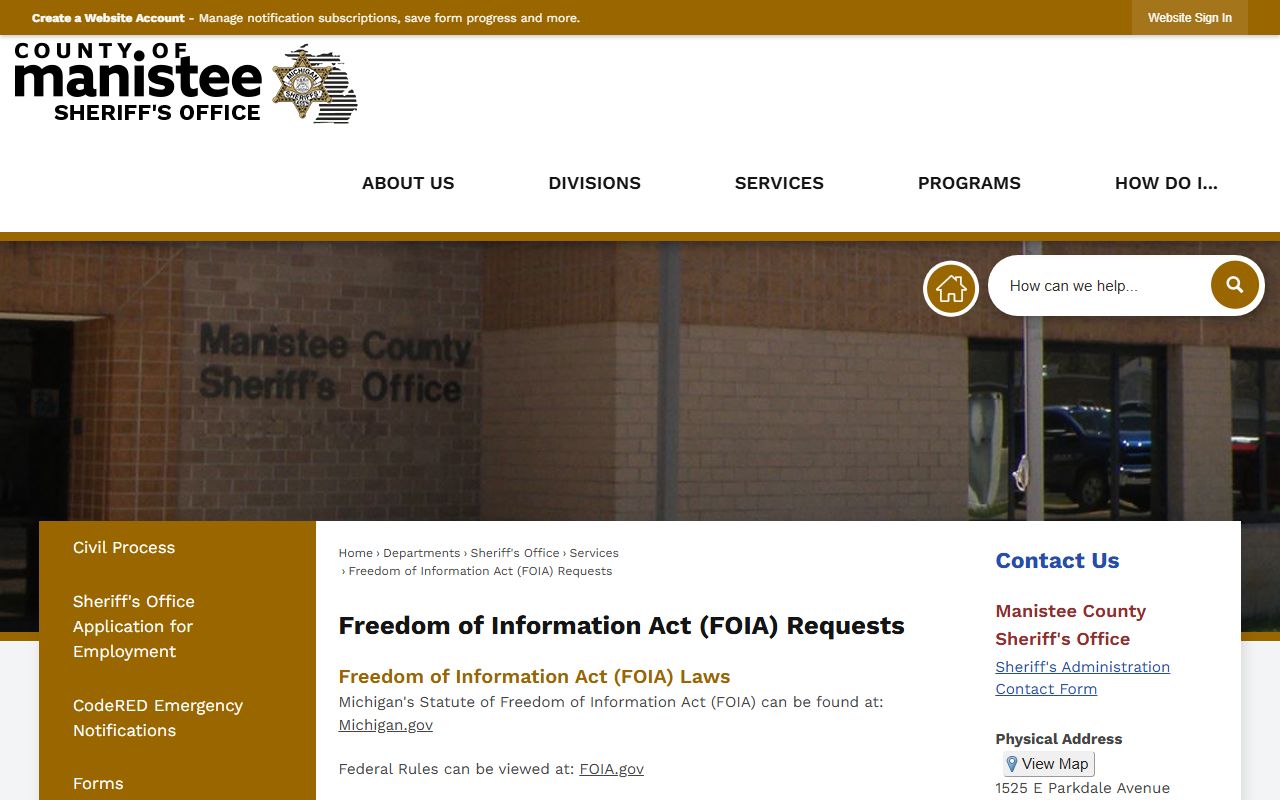
Police records are handled on a different track. Incident reports without pending charges go to the sheriff through a public-records request, while reports tied to a pending charge are routed to the prosecutor. The Sheriff's Office FOIA page, shown below, lays out how to file that request.
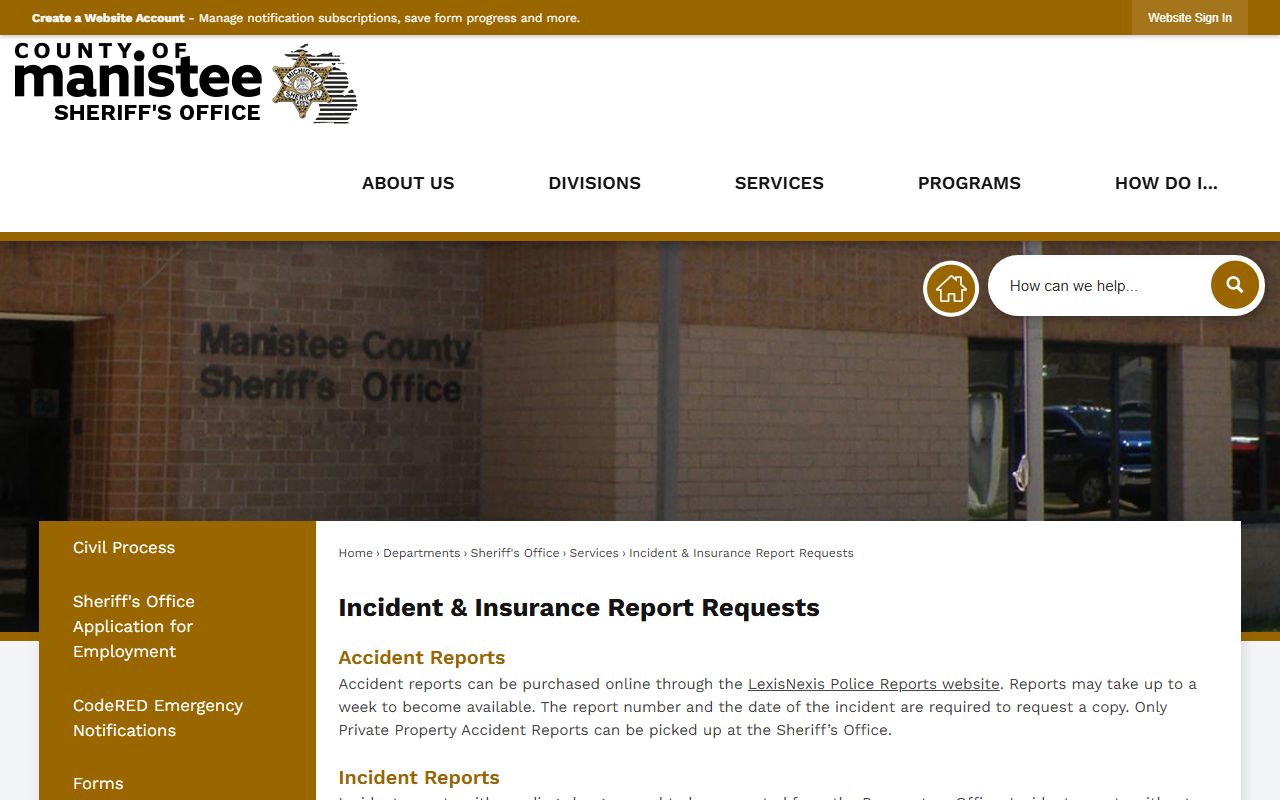
Accident and incident reports have their own request page. The incident and insurance report page separates pending-charge reports, nonpending reports, and accident reports, and it notes the copy costs, as the screenshot shows.
Court case copies, though, always come from the clerk, not from the sheriff.
Note: a court record request goes to the clerk who holds the case, while a sheriff record request goes through the FOIA channel, and the two should not be mixed up.
Restricted Criminal Court Records in Manistee County
Some criminal court records are closed by law. Juvenile cases are the clearest example. Under MCL 712A.28, juvenile court records are kept by the court and opened only by court order to a person with a legitimate interest, so they usually will not return in a public name search. Diversion matters are handled apart from the main file as well.
Other files are shielded for their subject matter. Probate handles involuntary mental health treatment, and those proceedings are sensitive and restricted rather than open like an estate file. Adoption records are closed after the adoption. A set-aside conviction drops out of public access even though it stays visible for some court and licensing uses.
For the full case file behind any public search result, including the outcome and sentence, the complete set of Manistee County court records and their access rules give the wider picture. When a record is sealed, the right step is to ask the convicting court, not the sheriff, about access.